


Laikipia, Kenya: A Vast Northern Landscape Shaping a Different Kind of Safari
 Laikipia, a vast region in north-central Kenya, covers approximately 3,700 square miles (about 9,500 square kilometers). Rather than being defined by one protected boundary, it functions as a network of private and community-owned conservancies, cattle ranches, and pastoral lands – a structure that fundamentally shapes how safari is experienced here.
The region sits on the Laikipia Plateau, at elevations ranging from roughly 5,500 to 7,000 feet above sea level, between the slopes of Mount Kenya and the more arid landscapes to the north. This elevation brings cooler temperatures than lower-lying savanna and supports a mix of open grassland, acacia and whistling-thorn woodland, and seasonal river systems.
The name Laikipia is widely believed to derive from the Maa language, often interpreted as “place of trees,” reflecting this relatively wooded landscape compared with northern Kenya’s drier regions.
A Working Landscape for Wildlife
What distinguishes Laikipia is not just its scale, but how the land is actively used.
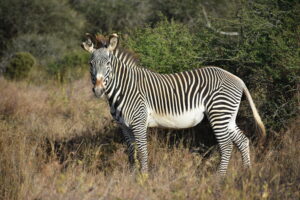
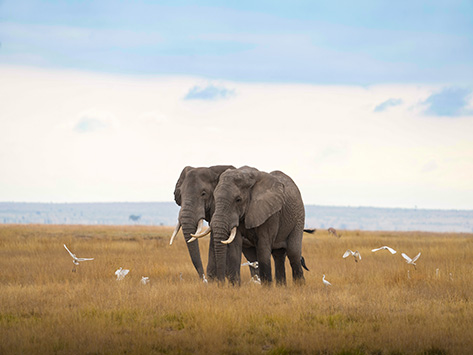
Much of the region is unfenced, allowing wildlife to move freely across long-established migration corridors. Elephants, predators, plains game, livestock, and people all share this landscape, making coexistence a daily reality rather than a theoretical concept. Conservation here is not separated from human presence; it is built around it.
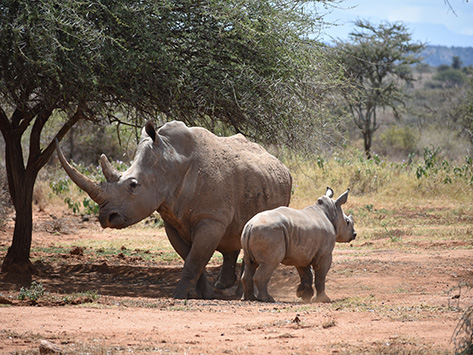
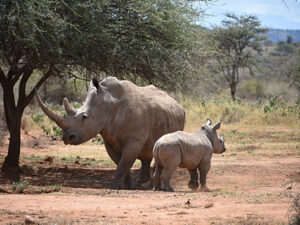
This approach has positioned Laikipia as one of East Africa’s most important conservation areas. The region supports a remarkable diversity of wildlife, including Grevy’s zebra, for which Laikipia represents one of the most significant remaining strongholds. It is also home to approximately half of Kenya’s black rhino population, alongside a protected and growing population of white rhino – making it a cornerstone of the country’s rhino conservation efforts.
Because wildlife is not concentrated around a single river or seasonal spectacle, sightings tend to unfold through tracking, time, and movement rather than immediacy. For many travelers, this creates a more nuanced understanding of the ecosystem itself.
How Safari Works in Laikipia
Safari in Laikipia operates differently than in Kenya’s national parks.
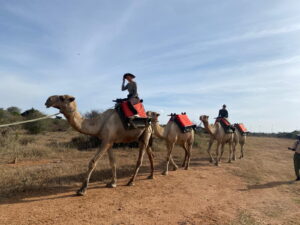
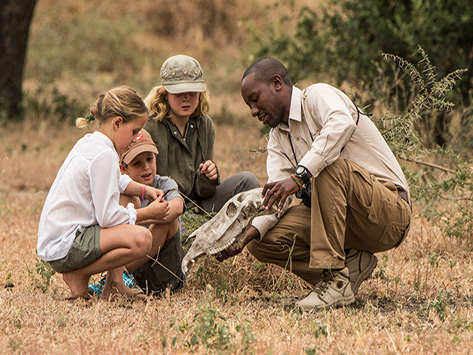
Camps and lodges are situated within individual conservancies, each responsible for land management, wildlife protection, and guest access. This structure allows for a broader range of activities than are permitted in national parks, including walking safaris, night drives, horseback riding, and camel safaris.
Camel safaris, in particular, reflect the region’s cultural fabric. Northern pastoralist communities such as the Samburu have long herded camels, animals well-adapted to semi-arid conditions. Their presence in safari experiences is not a tourism invention, but an extension of everyday life on the plateau.
With relatively few camps spread across a very large area, the sense of space is immediate. It is common to spend extended time tracking wildlife without encountering other vehicles. Laikipia accommodates a wide spectrum of safari styles – from focused, activity-driven days to slower, observation-led experiences – depending on how a journey is designed.
A Laikipia Perspective: Ol Lentille
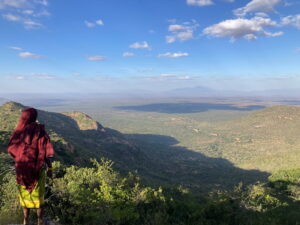
As Bushtracks’ Director of Group Expeditions, Daniela Powers has visited a wide range of safari regions across Africa. Laikipia is one that continues to stand out.
“I’ve visited my share of unique and wonderful safari camps and destinations,” she says, “but occasionally, one resonates so deeply that it keeps echoing in my memories. One such place for me is Ol Lentille in the far northern reaches of Laikipia.”
Set high along the edge of the plateau, Ol Lentille offers a highly private approach to safari, with just four villas positioned to take in sweeping views clear across Laikipia. Each stay is shaped collaboratively, without a fixed program – from walking and camel safaris to time spent with local communities.
“You’re not here to tick off the Big Five – although there is no shortage of wildlife,” Daniela explains. “Being far away from crowds and vehicle traffic allows you to immerse yourself in a slower safari and experience what wilderness really means.”
What resonates most for her is the nature of cultural exchange. “Guests are treated as guests, not tourists. You’re invited into everyday moments – conversations, ceremonies, shared time – rather than staged experiences.”
Within the broader context of Laikipia, Ol Lentille represents one expression of the region’s approach to safari: highly private, deeply place-based, and grounded in long-term community stewardship.
Why Attention Is Turning to Laikipia
In recent years, Laikipia has drawn increased attention from safari planners and conservation-focused travel organizations. The African Travel & Tourism Association has highlighted the region for its combination of high conservation value, low visitor density, and models that directly benefit local communities.
As traveler preferences continue to evolve – with greater emphasis on access, impact, and flexibility – Laikipia offers a framework that supports all three. It is a region that rewards time and thoughtful design, whether experienced on its own or as part of a broader East African journey.
Where Laikipia Fits – and Why Design Matters
Laikipia’s strength lies in its versatility. It can deliver intensity or immersion, structure or spontaneity, depending on how a journey is planned. It also pairs naturally with other regions – from the Masai Mara to northern Kenya and beyond – making it a compelling foundation for longer, more layered safaris.
There are also moments when timing creates additional opportunity. At certain points of the year, we have access to high-value benefits at select camps and lodges – whether through extended stays, added flexibility, or enhanced value across a multi-region itinerary. Sometimes these opportunities help shape a journey from the outset; other times they complement an experience once it has been defined.
This is one of the benefits of working with Bushtracks. Our role is to understand how landscapes function, how camps and conservancies relate to one another, and how timing, access, and experience align. In a region as expansive and nuanced as Laikipia, that level of design allows the safari to unfold in a way that feels considered, balanced, and deeply memorable.
We’d love to help you craft a custom safari around Laikipia, a deeply private, space-rich experience that brings together privacy and scale, access and insight.
*All photos taken by Daniela Powers, Director of Group Expeditions